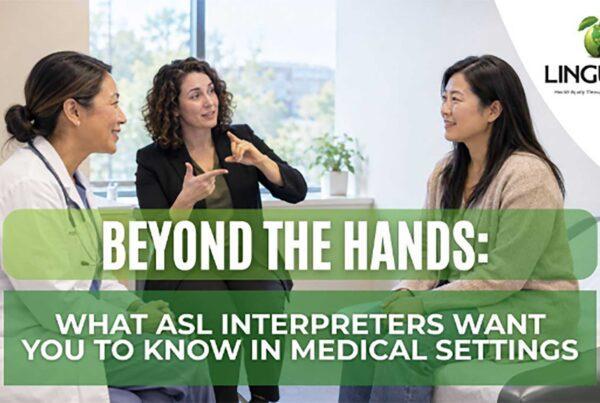


In this message, Leah Owens shares why ASL is not a form of English and why qualified ASL interpreters are essential in medical settings. Clear communication is not just compassionate care, it is a legal requirement under the Americans with Disabilities Act (ADA). When healthcare providers ensure effective communication for Deaf patients, appointments become safer, more respectful, and more equitable.
Language access in medical settings is not a luxury for Deaf patients. It is a necessity.
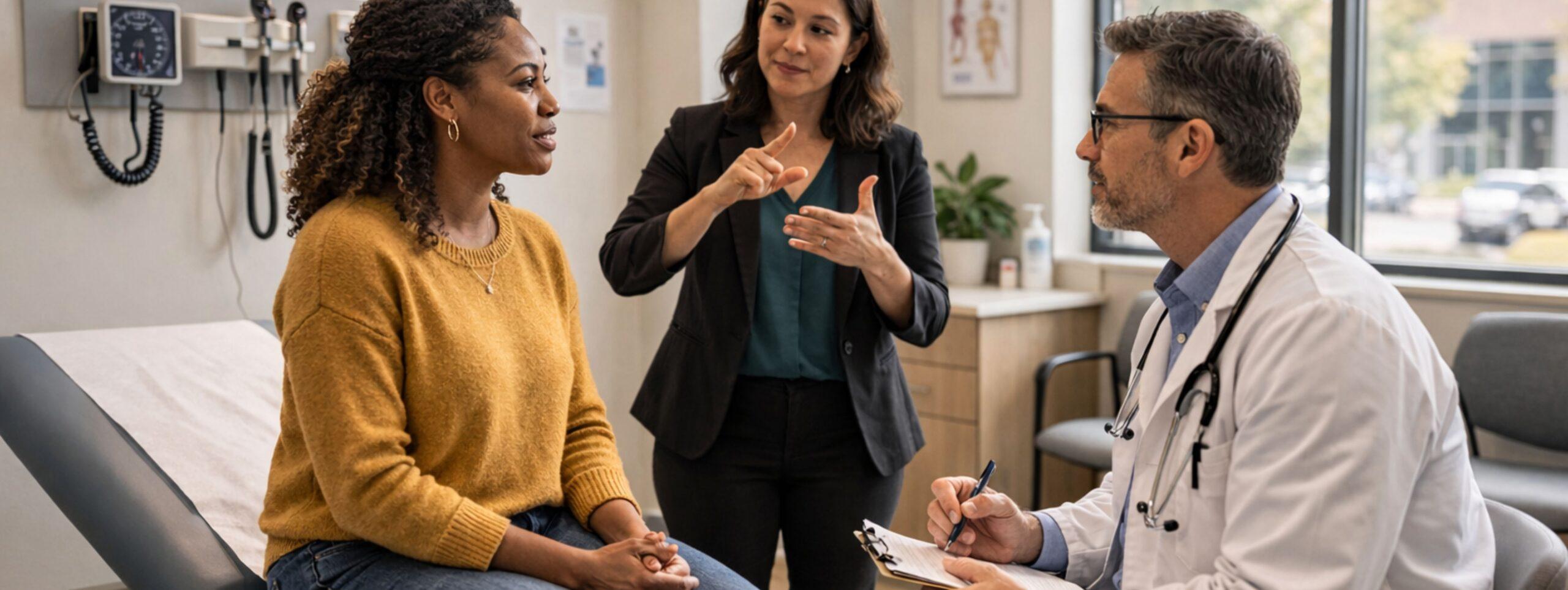
In more than 20 years as an American Sign Language interpreter, I have had a front-row seat to both the relief and the frustration Deaf patients experience in healthcare environments. I have watched shoulders visibly relax when I enter a room. I have also seen anxiety rise when patients realize no interpreter has been arranged for future visits. Communication is not a courtesy. It is central to safe, ethical medical care.
Recently, I interviewed a Deaf woman named Isomar about her experiences in medical settings. Her perspective reflects what I have witnessed throughout my career.
ASL Is a Language, Not a Simplified Form of English
“ASL is not English,” she explained.
For many Deaf individuals, ASL is their first language, with its own grammar and structure. Handing a patient a clipboard and expecting complex medical dialogue to unfold through written English is often ineffective, especially when discussing diagnoses, surgical risks, or medication instructions.
Isomar also emphasized something that should not need clarification. “Deaf does not mean stupid.” The barrier is communication, not intelligence. When providers oversimplify explanations or avoid deeper discussion because a patient is Deaf, they limit that patient’s autonomy and dignity.
ADA Requirements and the Right to a Qualified Interpreter
Effective communication is not optional. It is a legal requirement under the Americans with Disabilities Act. The U.S. Department of Justice makes clear that healthcare providers must ensure effective communication with Deaf patients, including providing qualified interpreters when necessary and at no cost to the patient.
Hospitals and clinics must provide qualified interpreters at no cost to the patient. Friends and family members are not substitutes. Using them can violate patient privacy and lead to serious inaccuracies, particularly when medical terminology or sensitive topics are involved.
Over the years, I have interpreted appointments where critical information had previously been filtered through well-meaning relatives. Patients sometimes learned details they had never been told. I have also seen the emotional toll placed on CODAs, or Children of Deaf Adults, who are asked to step into the role of interpreter. In those moments, they are no longer simply sons or daughters. They are expected to become neutral conveyors of complex and sometimes devastating information.

Why Scheduling and Interpreter Logistics Matter
Timing matters more than many realize.
“Book the interpreter early,” Isomar advised. Waiting until the last minute increases the likelihood of delays or inadequate alternatives.
When an in-person interpreter is unavailable, Video Remote Interpreting can serve as a secondary option, but only if it is functioning properly, positioned correctly, and fully charged. I have seen appointments derailed by weak internet connections, dead batteries, or devices placed where the patient cannot clearly see the screen.
Positioning is critical. The Deaf patient must be able to see both the provider and the interpreter. Providers should always face and speak directly to the patient, not the interpreter, maintaining eye contact and natural conversation flow.

Practical Ways Medical Offices Can Improve Communication Access
There are simple tools every medical office can keep on hand to support communication access:
- Working pens, clipboards, and paper
- A small, clean whiteboard for brief clarification
- Visual aids that explain common medical terms or procedures
- A designated, fully charged device for Video Remote Interpreting
After more than two decades in this field, reinforced by voices like Isomar’s, one truth remains consistent. When medical professionals treat language access as essential care, planning ahead, respecting Deaf patients as equal partners, and using qualified interpreters, appointments become safer, more effective, and more humane for everyone involved.
Strengthening ASL Interpretation in Healthcare
At Linguava, we have seen how qualified interpreters transform healthcare experiences every day. Our teams partner with providers, clinics, and health systems to integrate reliable ASL interpretation into care workflows, reduce miscommunication risks, and support compliance with federal language access requirements. We bring certified interpreters, training, and operational support to help care teams deliver communication that is clear, respectful, and patient-centered. When language access is treated as part of the care itself, healthcare becomes safer and more equitable for Deaf patients and everyone they rely on. If you are ready to strengthen language access in your organization, we’re here to help you take the next step.
Connect with our team of experts today.
Author
Leah Owens is a National Account Executive at Linguava and brings more than 20 years of experience as an American Sign Language interpreter in medical and community settings. Holding the National Interpreting Certification since 2009, her background in direct patient care impacts her work with healthcare organizations seeking to improve language access for Deaf patients. Leah is passionate about communication that allows Deaf patients to fully understand and participate in their care, and in training the next generation of interpreters on best practices.